Quê Me Quê Me: Action for democracy in Vietnam & Vietnam Committee on Human Rights
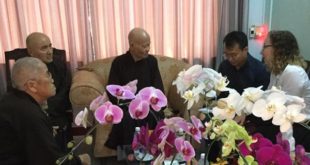
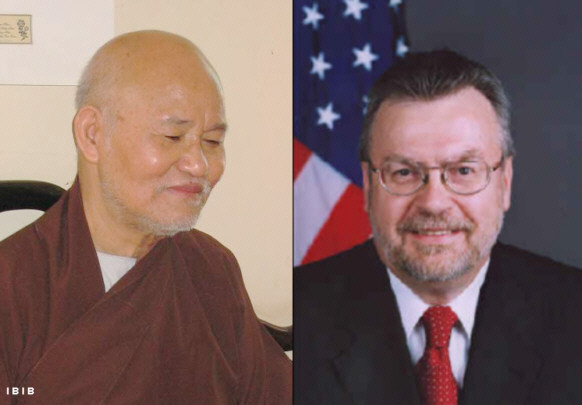 The International Buddhist Information Bureau (IBIB) is informed that the United States Ambassador to Vietnam, Michael W. Marine paid a visit to the Very Venerable Thich Quang Do, Deputy Head of the banned Unified Buddhist Church of Vietnam (UBCV) today at the Thanh Minh Zen Monastery. He was accompanied by the U.S. Consul General Seth D. Winnick and members of staff. Ambassador Marine travelled from Hanoi to Ho Chi Minh City for the visit. This is the first time the U.S. Ambassador has met with Venerable Thich Quang Do, who has been under effective house arrest since October 2003 following a government crackdown on the outlawed UBCV.
The meeting lasted over an hour (from 2.15 pm to 3.40 pm). In a phone conversation with IBIB Director Vo Van Ai, Venerable Thich Quang Do said the U.S. Ambassador was open and well-informed, and that their meeting had been very positive and friendly. He asked IBIB not to reveal details of their talks.
This is one of several diplomatic visits paid by U.S. diplomats to leaders of the outlawed UBCV. On November 21st, Ambassador Marine visited UBCV Patriarch Thich Huyen Quang, who was then gravely ill in Quy Nhon Hospital. On the same day, a delegation from the U.S. State Department led by Ms Elizabeth Dugan, Deputy Assistant Secretary of State for Democracy, Human Rights and Labour, visited Venerable Thich Quang Do at the Thanh Minh Zen Monastery with the U.S. Consul General to discuss religious freedom issues and the situation of the banned UBCV.
Religious freedom is currently a sensitive issue between the United States and Vietnam. In September 2004, the U.S. placed Vietnam on a blacklist of eight countries designated as “countries of particular concern” (CPCs) for grave abuses of religious freedom. Under the International Religious Freedom Act, the U.S. may take measures – including economic sanctions – against CPCs if they do not improve religious rights. On 15th March, the State Department will decide whether to maintain Vietnam’s CPC designation. Vietnam is vigorously campaigning for the U.S. to remove Vietnam from this list – in December, a top legislative envoy toured 8 U.S. states and 12 cities to plead Vietnam’s cause. According to Venerable Thich Quang Do and other religious leaders, however, until now, the Vietnamese authorities have taken no concrete steps to cease repression against non-recognized religious bodies in Vietnam.
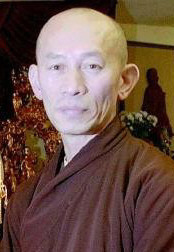 l On 28th December 2004, after devastating tsunamis hit Asia and East Africa at the year-end, the Overseas Unified Buddhist Church of Vietnam launched an appeal to UBCV Buddhists worldwide to send urgent contributions to the victims. Over the past few days, donations have poured in from Buddhists around the world. One special donation came from Venerable Thich Nguyen Thao, UBCV Superior monk at the Hoa Nghiem Pagoda in Vancouver, Canada, who is giving over half a million Canadian dollars to the tsunami aid fund. After receiving the UBCV’s appeal, Thich Nguyen Thao decided to sell one of the Meditation Centres he runs in Vancouver and send the proceeds to tsunami victims. Since the Canadian government has pledged to double all funds raised before January 11th 2005, Venerable Thich Nguyen Thao’s donation could well become over 1 million Canadian dollars if the sale can be made in time.